
High-Asset Divorce Lawyer in Chicago
A high-asset divorce lawyer in Chicago can help protect your financial interests when significant wealth, property, or business assets are involved in a divorce. High-asset divorces often include complex financial matters such as business ownership, investment portfolios, retirement accounts, and valuable property.
Divorce cases involving substantial assets can create disputes over property division, spousal support, and financial disclosure. Illinois law requires equitable distribution of marital property, but determining how assets should be divided often requires detailed financial analysis.
Table of Contents
Toggle
“High-asset divorces often involve complex financial considerations that require careful review and accurate valuation under Illinois law.”
If you are facing a high-asset divorce, legal guidance can help safeguard your financial future. Call The Rogoff Law Group P.C. at (847) 768-2194 for a consultation and discuss your situation with a high-asset divorce lawyer in Chicago.
What Is a High-Asset Divorce?

A high-asset divorce involves the division of substantial marital property and financial holdings. These cases often require careful examination of income sources, business interests, investments, and other high-value assets.
Common assets involved in high-asset divorce cases include:
- Business ownership interests
- Investment portfolios
- Retirement accounts
- Real estate holdings
- Luxury vehicles or valuable personal property
- Stock options or executive compensation packages
When significant wealth is involved, accurate valuation and financial transparency become critical components of the divorce process.
Unique Challenges in High-Asset Divorce Cases
High-asset divorces often involve financial complexities that extend beyond those found in standard divorce cases. Detailed documentation and financial analysis may be required to ensure fair distribution.
Some common challenges include:
Asset Valuation
Determining the value of businesses, real estate, investments, and retirement accounts can require professional evaluation. Accurate valuations help ensure that assets are divided fairly.
Complex Financial Structures
High-net-worth individuals may hold assets through trusts, corporations, partnerships, or other financial entities. Understanding these structures is often necessary when dividing marital property.
Hidden Assets
One spouse may attempt to conceal income or assets during divorce proceedings. Financial records, bank statements, and business documents often require review to ensure complete disclosure.
Tax Consequences
Dividing large financial assets may create significant tax implications. Proper planning may help reduce financial losses related to taxation.
Property Division in Illinois High-Asset Divorces
Illinois follows an equitable distribution system when dividing marital property during divorce. This approach is guided by the Illinois Marriage and Dissolution of Marriage Act. This approach means the court divides assets in a manner considered fair rather than automatically splitting them equally.
Factors courts may consider include:
- The length of the marriage
- Each spouse’s financial contributions
- Non-financial contributions such as caregiving
- The financial circumstances of each spouse
- The value of marital property
- Future earning potential of each spouse
Property acquired during the marriage is generally considered marital property, while assets acquired before marriage may be treated as separate property.
Business Ownership and Divorce
Business ownership can significantly complicate divorce proceedings. Determining how to divide or value a business often requires careful analysis.
Several outcomes are possible when a business is involved:
One Spouse Buys Out the Other
In some situations, one spouse may retain ownership of the business and compensate the other spouse through a financial settlement or other assets.
Business Sale and Division of Proceeds
A business may be sold during divorce proceedings, with the proceeds divided between the spouses.
Continued Co-Ownership
Some couples maintain joint ownership of a business after divorce, though this arrangement may require detailed legal agreements.
Proper valuation and financial documentation often play a key role in determining the most appropriate solution.
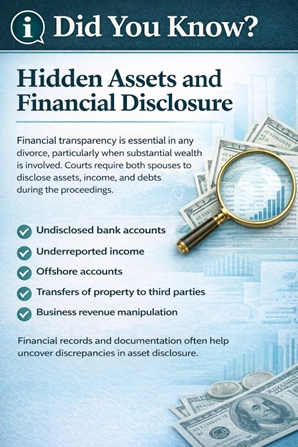
Hidden Assets and Financial Disclosure
Financial transparency is essential in any divorce, particularly when substantial wealth is involved. Courts require both spouses to disclose assets, income, and debts during the proceedings.
Hidden assets may appear in several forms, including:
- Undisclosed bank accounts
- Underreported income
- Offshore accounts
- Transfers of property to third parties
- Business revenue manipulation
Financial records and documentation often help uncover discrepancies in asset disclosure.
Spousal Support in High-Asset Divorce Cases
Spousal support, also called maintenance in Illinois, may play an important role in high-asset divorce cases. Courts consider several factors when determining whether support should be awarded.
These factors may include:
- Income and property of both spouses
- Length of the marriage
- Standard of living established during the marriage
- Age and health of each spouse
- Future earning capacity
In high-asset cases, maintenance payments may involve significant financial amounts depending on the circumstances.
Retirement Accounts and Investments in Divorce
Retirement savings and investment portfolios often represent a large portion of marital wealth. These accounts may include:
- 401(k) plans
- Individual retirement accounts (IRAs)
- Pension plans
- Stock portfolios
- Deferred compensation plans
Dividing retirement accounts may require a legal document known as a Qualified Domestic Relations Order (QDRO). This order allows funds to be transferred between spouses without immediate tax penalties.
Real Estate Division in High-Asset Divorce
High-net-worth couples often own multiple real estate properties. These properties may include:
- Primary residences
- Vacation homes
- Investment properties
- Rental properties
- Commercial real estate
Property division may involve selling the property, transferring ownership, or offsetting the value with other marital assets.
Accurate property valuation plays a significant role in determining fair distribution.
Prenuptial and Postnuptial Agreements
Prenuptial and postnuptial agreements can influence how assets are divided during divorce.
These agreements often address issues such as:
- Property ownership
- Asset division
- Spousal support
- Debt responsibility
Courts generally enforce these agreements when they were entered voluntarily and meet legal requirements.
How a High-Asset Divorce Lawyer Can Help
High-asset divorce cases often require legal guidance combined with financial analysis. A lawyer can help protect your interests throughout the divorce process.
Legal representation may include:
Financial Investigation
Reviewing financial records can help identify assets, income sources, and potential discrepancies in financial disclosure.
Asset Valuation Coordination
Professional appraisers, accountants, and financial professionals may evaluate businesses, real estate, and investment holdings.
Negotiation and Settlement Strategy
Many high-asset divorce cases resolve through negotiated settlements. Careful negotiation may help protect your financial interests.
Litigation When Necessary
If negotiations fail, the case may proceed to court where a judge will determine how assets are divided.
Frequently Asked Questions About High-Asset Divorce
High-asset divorces often raise complex financial questions. The following answers address several common concerns individuals may have when navigating a divorce involving substantial wealth.
What qualifies as a high-asset divorce?
A high-asset divorce typically involves significant marital property such as businesses, investment portfolios, retirement accounts, or multiple real estate properties. These cases often require financial analysis to determine asset values and ensure accurate financial disclosure during the divorce process.
How are businesses valued during divorce proceedings?
Business valuation often involves financial professionals who analyze revenue, profits, assets, liabilities, and market conditions. These evaluations help determine the fair market value of the business. Courts use this information when deciding how the business should be divided or offset with other assets.
Can hidden assets affect a divorce case?
Yes. Failing to disclose assets during divorce proceedings can lead to serious legal consequences. Courts expect both spouses to provide complete financial disclosure. If hidden assets are discovered, the court may impose penalties or adjust the property division accordingly.
How are retirement accounts divided in a high-asset divorce?
Retirement accounts are often considered marital property if contributions occurred during the marriage. A Qualified Domestic Relations Order may be used to transfer funds between spouses without triggering immediate tax penalties. The exact division depends on the circumstances of the case.
Will a prenuptial agreement determine how assets are divided?
In many cases, a valid prenuptial agreement will guide how property is divided during divorce. Courts generally enforce these agreements if both parties entered them voluntarily and the terms meet legal standards under Illinois law.
Speak With a High-Asset Divorce Lawyer in Chicago
A divorce involving significant assets requires careful planning and legal guidance. Protecting your financial interests during property division can affect your future for years to come.
Call The Rogoff Law Group P.C. at (847) 768-2194 to get started with a consultation with a high-asset divorce lawyer in Chicago and discuss your legal options today.